Rider University to End Long-Running China Academic Partnership as Financial Recovery Efforts Continue
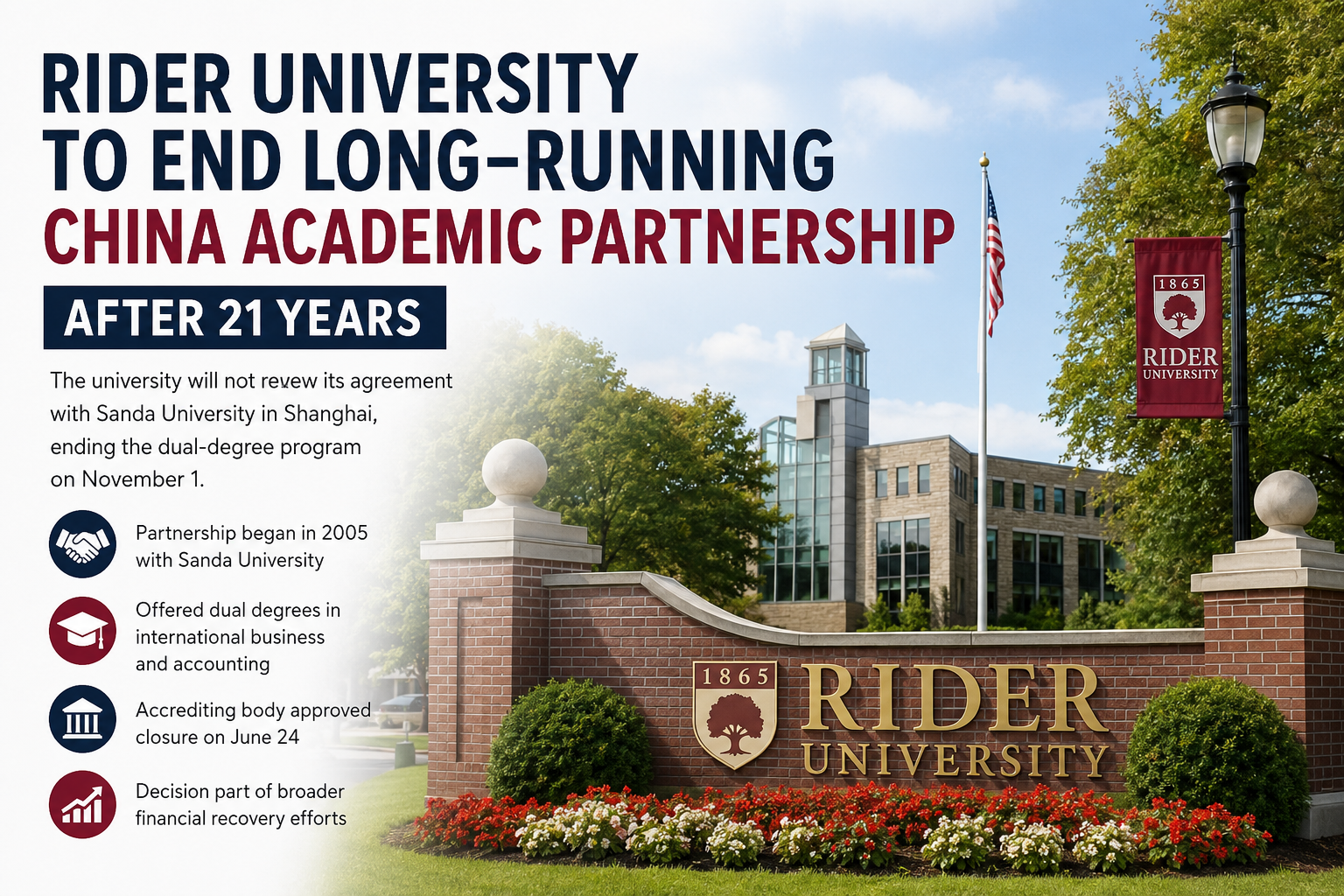
Rider University will officially end its long-standing academic partnership with Sanda University in Shanghai later this year, bringing a 21-year international education programme to a close. The decision comes as the New Jersey-based private university continues to address financial challenges while working to strengthen its long-term stability.
The partnership, known as the Sanda-Rider Cooperative Program, has connected students in the United States and China since 2005 through dual-degree programs focused on international business and accounting. The initiative gave students the opportunity to study in both countries while earning degrees designed to prepare them for careers in the global business world.
University officials confirmed that the agreement with Sanda University will not be renewed when it expires on Nov. 1. According to the university, participation in the joint academic programme has steadily declined in recent years, making it difficult to justify continuing the partnership.
Because Sanda University was recognised as an additional instructional location under Rider University’s accreditation, the university was required to receive approval from its accrediting agency before closing the programme. The Middle States Commission on Higher Education approved the request on June 24, allowing Rider to move forward with the transition.
University representatives emphasised that ending the China partnership is an operational decision and does not affect Rider University’s accreditation. Officials stated that the closure is separate from the institution’s ongoing accreditation review and should not be viewed as a sign of academic concerns.
The international partnership offered students several combined degree pathways, including programmes that allowed them to earn both bachelor’s and master’s degrees. Participants completed coursework in China and the United States while gaining experience in international business practices, cross-cultural communication, and global markets.
Although the university confirmed the partnership will end, it has not publicly disclosed how many students remain enrolled in the programme or how current participants will complete their degrees. Rider has indicated that appropriate academic arrangements will be made as the partnership concludes.
The decision arrives during a period of significant financial restructuring for Rider University. In recent years, the institution has taken multiple steps to reduce expenses and improve its financial position after facing budget pressures that affected its overall operations.
Last year, the Middle States Commission on Higher Education placed Rider University on probation due to financial concerns. While probation allows the university to continue operating and enrolling students, it also requires the institution to demonstrate measurable progress in improving its financial health and long-term sustainability.
University leadership has repeatedly stated that Rider remains committed to meeting accreditation standards and maintaining a strong academic environment for students. Officials have expressed confidence that the financial recovery plan is producing positive results and that the university continues to move in the right direction.
As part of its broader recovery strategy, Rider has implemented several cost-saving measures. These have included workforce reductions, salary adjustments for many employees, and efforts to generate additional revenue through campus property transactions. One major step involved an agreement to sell a portion of university-owned land to Mercer County as part of a financial support plan valued at approximately $10 million.
Despite the closure of its China partnership, Rider continues to serve approximately 3,700 students at its Lawrenceville, New Jersey campus. University leaders say their primary focus remains on strengthening academic programmes, supporting students, and ensuring the institution’s financial future.
International partnerships have become an important part of higher education over the past two decades, allowing universities to expand learning opportunities beyond national borders. However, many colleges and universities have recently reassessed these arrangements because of changing enrolment patterns, shifting student demand, financial pressures, and evolving global education trends.
Rider’s decision reflects a broader reality facing many higher education institutions as they evaluate which programmes continue to serve students effectively while remaining financially sustainable. Rather than expanding international operations, universities are increasingly focusing on initiatives that align with current enrolment needs and available resources.
The Middle States Commission is expected to continue reviewing Rider University’s financial progress during its upcoming meetings. The outcome of those reviews will play an important role in determining the university’s accreditation status moving forward. For now, university officials maintain that the institution remains fully committed to providing quality education while carrying out its financial recovery plan.
Sources
- Rider University
- Middle States Commission on Higher Education (MSCHE)
- NJ Advance Media / NJ.com