Yankees’ Late-Season Offensive Puzzle Puts Jazz Chisholm Jr. Back in the Spotlight
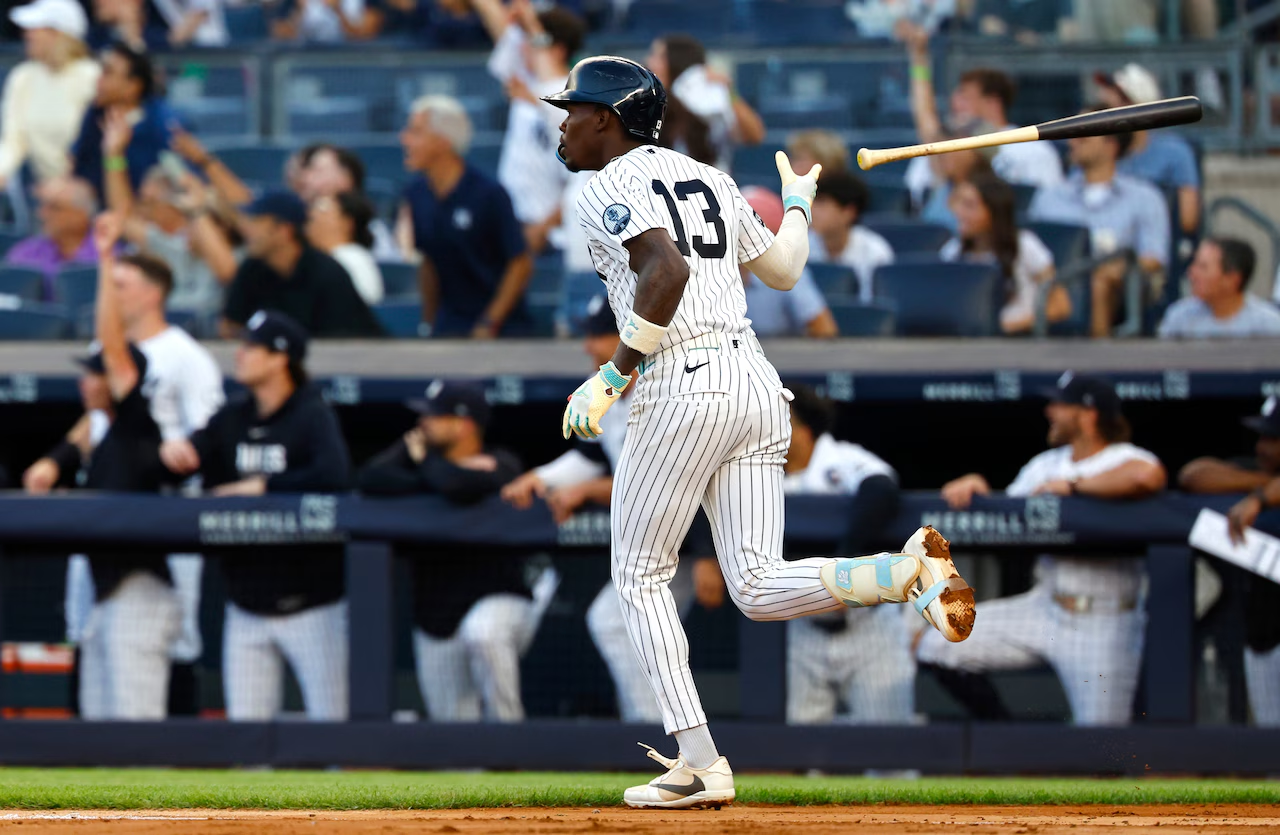
The New York Yankees are entering the part of the season when every lineup decision can carry extra weight, and one of their biggest questions is what to do with Jazz Chisholm Jr.
Chisholm has not produced the kind of offensive season he expected when the year began. The Yankees’ second baseman entered 2026 with considerable expectations after showing the combination of power and speed that has made him one of the more exciting players on the roster. Instead, his production at the plate has been inconsistent, leaving New York searching for answers as the postseason race becomes increasingly important.
That has led to an interesting debate inside and around the Yankees: should manager Aaron Boone continue giving Chisholm regular opportunities against right-handed pitchers, or should he turn more often to José Caballero when the matchup calls for it?
Yankees broadcaster and former pitcher David Cone believes Chisholm still deserves that opportunity.
During New York’s 4-3 victory over the Toronto Blue Jays on Sunday, Cone argued that the Yankees should continue giving Chisholm opportunities against right-handed pitching because of the possibility that the talented infielder could suddenly find his rhythm. His point was less about ignoring Chisholm’s struggles and more about recognising what the player could potentially provide if he gets hot at the right time.
That distinction matters for a Yankees team that cannot afford to leave offensive possibilities unexplored with the season moving toward its final weeks.
Chisholm’s 2026 numbers explain why the discussion has become necessary. He has been hitting around the .216 mark, with 17 home runs, 32 stolen bases, 48 RBIs and an OPS in the .680 range. Those numbers are a long way from the type of production Chisholm envisioned when he spoke confidently during spring training about potentially joining baseball’s exclusive 50-home-run, 50-stolen-base club.
His speed, however, remains one of his most valuable weapons. Even during an uneven offensive campaign, Chisholm has continued to create pressure on opposing defences with his ability to steal bases and take extra bases. Current statistical listings have him around 30 stolen bases while maintaining significant power potential.
That combination is one reason Cone’s argument has merit. A player does not need to be producing at an elite level every night to remain dangerous, particularly when that player has demonstrated the ability to change a game with one swing or his legs.
The Yankees got a glimpse of that upside earlier this summer. Chisholm had a two-home-run, five-RBI performance against Pittsburgh in July, helping New York win 8-5. The performance served as a reminder that the ceiling remains extremely high, even if he has struggled to maintain that level consistently.
The challenge for Boone is finding the right balance between potential and current production.
That became especially clear against Toronto. Rather than automatically putting Chisholm at second base against right-handed starter Dylan Cease, Boone went with Caballero. The decision was understandable given Chisholm’s recent struggles and Caballero’s ability to contribute in several areas of the game.
Caballero responded with an important performance.
He reached base, scored a run and delivered a seventh-inning single that brought George Lombard Jr. home. His contribution came during a game in which the Yankees needed timely offence, making the decision to start him look particularly effective. Chisholm entered later as a pinch runner and eventually recorded a hit and stole a base, showing that he could still influence the game even without starting.
That performance creates another layer to the Yankees’ decision-making.
Caballero is not simply a backup option who can fill a position when needed. He offers versatility, speed and the ability to provide useful at-bats, making him a legitimate part of Boone’s lineup calculations. Earlier in the season, the Yankees highlighted his defensive versatility and speed while also pointing to the possibility that his offensive game could develop further.
At the same time, Caballero’s success in one game does not necessarily mean Chisholm should lose his role.
Baseball is particularly unforgiving when decisions are made from a single performance. A player can go 0-for-4 one night and hit two home runs the next. The same is true in reverse. That makes the Yankees’ situation more complicated than simply choosing whichever player performed better most recently.
The matchup could ultimately determine how Boone handles the position.
Chisholm bats from the left side, which can give him a favourable matchup when New York faces a right-handed pitcher. That is the specific situation Cone was discussing when he advocated giving Chisholm another chance to get going. The Yankees can benefit from that matchup if Chisholm is able to turn his speed and power into more consistent offensive production.
The timing is also important.
New York has already dealt with stretches in which its offence has struggled to produce consistently. The Yankees have relied on contributions from different parts of the roster, including Trent Grisham, Ryan McMahon and other players, while several important names have dealt with injuries or absences. New York recently moved to 69-55 after its comeback victory over Toronto, showing that the club remains firmly in the postseason picture.
The Yankees also recently showed how quickly their offence can change when multiple hitters begin producing. In their series against Seattle, New York rallied for a 4-1 victory and then exploded for a 10-5 win, with Trent Grisham hitting two home runs and driving in four runs in the second game.
That is precisely why Chisholm remains an intriguing piece.
The Yankees do not necessarily need him to become the player who was discussed during spring training. They simply need more consistent contributions from him at a time when the margin for error is shrinking.
If Chisholm can raise his batting average, get on base more frequently and continue using his speed, his overall value could increase quickly. A productive Chisholm also gives Boone another way to construct a dangerous lineup without relying entirely on the team’s biggest stars.
For Boone, the answer may not have to be an either-or decision between Chisholm and Caballero.
Instead, the Yankees could continue using matchups, recent form and defensive needs to determine who starts on a particular day. Caballero has shown that he can take advantage of an opportunity, while Chisholm has already shown that he can produce game-changing moments when his swing is working.
Cone’s argument essentially comes down to one question: is Chisholm too talented to stop giving chances to?
With the Yankees heading into the final portion of the regular season, the answer may be yes, particularly against right-handed pitching.
The risk is obvious. Continuing to play a struggling hitter could cost the Yankees valuable opportunities if the results do not improve. But the potential reward is just as significant. If Chisholm finds his swing in August or September, New York could suddenly have another dynamic offensive threat capable of changing games with both power and speed.
For a team with postseason ambitions, that possibility may be worth pursuing.
Caballero has made the decision more difficult by proving that he deserves opportunities of his own. Chisholm, meanwhile, still has enough talent and upside to make a strong case for patience.
The Yankees now have to decide how much they value immediate production versus the possibility of a late-season breakthrough.
That decision could become one of the more important lineup questions for Boone as New York pushes toward October.
Sources
Major League Baseball — Yankees coverage and player information.
FanGraphs — Jazz Chisholm Jr’s 2026 statistical information.
CBS Sports — Jazz Chisholm Jr. 2026 statistics and game information.
Reuters — Recent Yankees game and offensive reports.