Questions Follow Scott Jennings as Attention Stays on Mitch McConnell’s Recovery
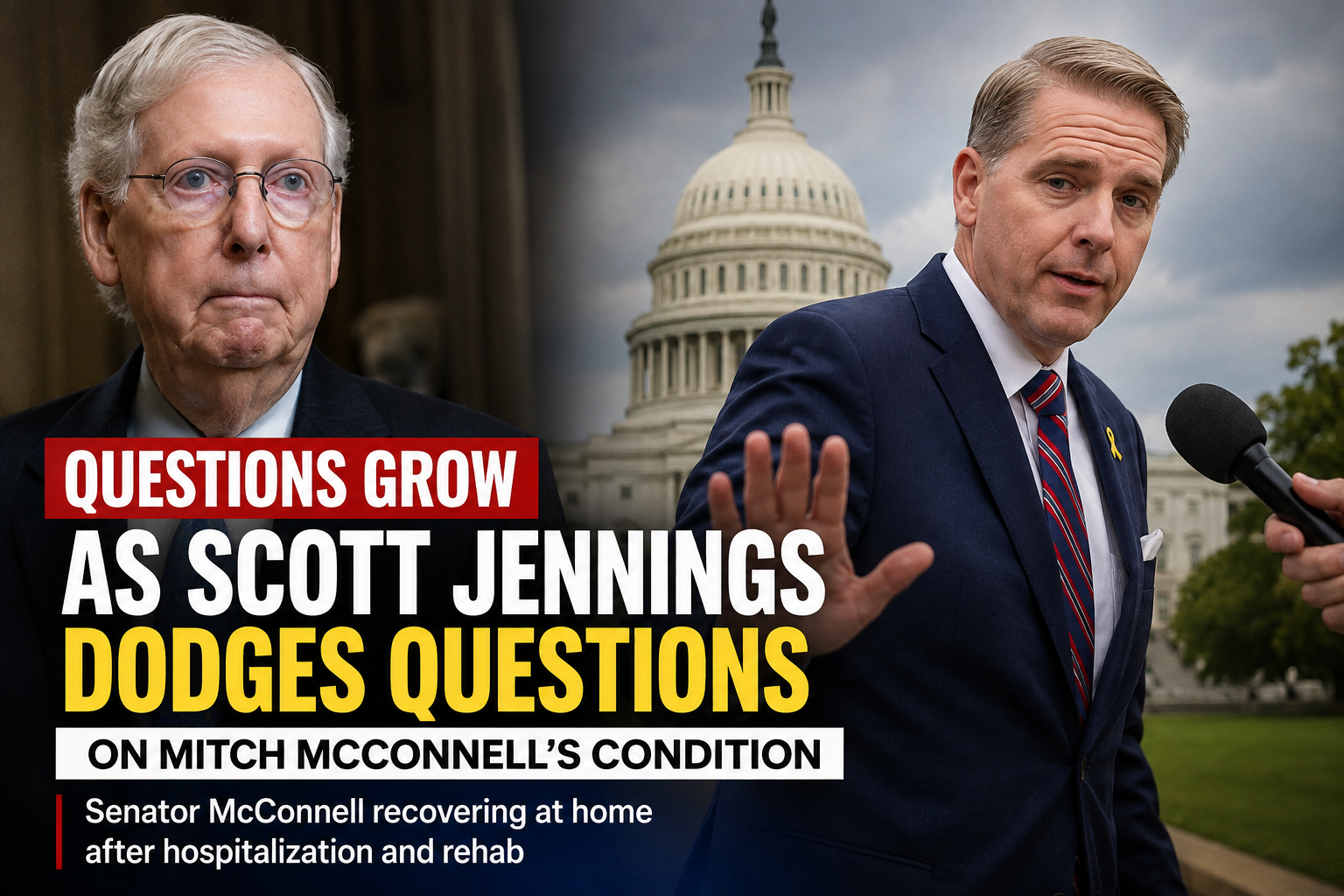
Questions about Sen. Mitch McConnell’s health took another turn this week after CNN political commentator Scott Jennings was approached by independent journalist Nicholas Ballasy and asked about the long-time Kentucky senator’s condition and whether McConnell should make a public video appearance.
The exchange came as McConnell continues recovering at home after spending weeks in medical care following a June 14 fall. Although McConnell’s office has issued several written updates, his limited public presence has continued to draw attention in Washington and online.
Ballasy, an independent correspondent based in Washington, approached Jennings on the street and began asking about McConnell. Among the questions was whether the senator should release a video updating the public on his condition.
Jennings did not engage with the questions and continued walking. Ballasy continued asking whether Jennings planned to visit McConnell in Washington and when he had last spoken with him. He also asked why McConnell had not released a video of himself.
The brief encounter quickly attracted attention because Jennings has previously said he has spoken directly with McConnell during the senator’s extended absence from public view.
Jennings has described McConnell as an old friend and has publicly defended the senator against speculation about his health. In early July, Jennings said he had spoken with McConnell by phone for nearly 20 minutes while the senator was still receiving care. According to Jennings, the conversation included international affairs, Senate history and other political subjects.
That earlier claim became part of a wider public debate because McConnell himself had not appeared publicly or spoken directly to reporters during his recovery. Some people questioned whether Jennings had actually spoken with him, while Jennings strongly rejected those doubts.
The issue has remained relevant even after McConnell provided additional information about his health.
McConnell, 84, said in a statement that he had been hospitalised after a fall on June 14. He later moved into a rehabilitation facility, where he underwent intensive physical therapy. He also disclosed that he developed a mild case of pneumonia during his hospital stay.
On Aug. 6, McConnell announced that he had been discharged from the rehabilitation facility and would continue recovering at home. He said he planned to continue following his doctors’ recommendations and remain engaged with his Senate work while recovering.
The senator has not announced a specific date for his return to Capitol Hill.
That uncertainty has become one of the central issues surrounding his absence. McConnell is in the final year of his Senate career and has already announced that he will not seek another term. His current term is scheduled to end in January 2027.
The Senate’s official records list McConnell as a Republican senator from Kentucky and show that his current term expires in January 2027. He is one of the chamber’s longest-serving members and has played a major role in Republican politics for decades.
His absence has therefore attracted attention beyond questions about his personal health. Lawmakers and political observers are also watching how his prolonged recovery affects Senate business and his ability to participate in legislative work.
At the same time, McConnell’s situation illustrates the difficult balance between a public official’s right to medical privacy and the public’s interest in knowing whether an elected representative is able to perform the duties of office.
Jennings has emphasised that McConnell has historically been private about his personal health. That privacy is particularly relevant because McConnell survived polio as a child and has dealt with mobility-related health challenges over the years.
Still, the lack of a direct public appearance has left room for continued speculation.
McConnell’s office has attempted to provide updates through written statements and photographs. Those updates have confirmed that he is recovering and has remained involved with his staff, but they have not answered every question about his day-to-day condition or when he will resume his normal Senate schedule.
That gap between official statements and the public demand for more information has helped keep the story alive.
The latest encounter involving Jennings adds another layer to that discussion. Ballasy’s questions focused not only on McConnell’s health but also on why the senator has not personally addressed the public through a video or other direct appearance.
Jennings’ decision not to answer those questions does not establish anything about McConnell’s medical condition. It also does not independently confirm or disprove the claims Jennings has previously made about his conversations with the senator.
What is established is that McConnell was hospitalised after a June fall, spent an extended period receiving medical and rehabilitation care, and has since returned home to continue his recovery. His office has also said that he intends to remain involved with Senate matters while he recuperates.
The continuing controversy is largely about transparency rather than a new medical diagnosis.
For McConnell, the coming weeks are likely to remain important. His recovery will determine when, or whether, he can return to the Capitol and resume a regular Senate schedule before his term ends.
For Jennings, meanwhile, the latest questions show why his earlier statements about McConnell remain under scrutiny. His previous account of speaking with the senator has made him one of the more visible people discussing McConnell’s condition, even though he is not a member of McConnell’s medical team or Senate office.
As of now, there is no verified public indication that McConnell has died or that the more extreme claims about his condition circulating online are accurate. Those claims should not be treated as established facts without confirmation from McConnell’s office, medical authorities or another authoritative source.
The most reliable picture remains the one provided through official statements: McConnell is alive, recovering at home after hospitalisation and rehabilitation, and has not given a firm timetable for returning to the Senate.
The questions directed at Jennings are therefore unlikely to end the broader discussion. Until McConnell makes a fuller public appearance or his office provides more detailed information about his recovery and expected return, public interest in the condition of one of Kentucky’s most influential political figures is likely to continue.
Sources
Associated Press — reporting on Mitch McConnell’s discharge from rehabilitation and continued recovery at home.
U.S. Senate — official Senate records and information concerning Mitch McConnell’s current term.
Office of Sen. Mitch McConnell — official statements and updates concerning his Senate work and public activities.
The Washington Post — reporting on McConnell’s rehabilitation and medical clearance to leave the facility.
CNN — reporting and coverage concerning Scott Jennings and his statements about McConnell.