New Jersey Appeals Court Says Schools May Restrict Teachers From Displaying Campaign Signs During Work Hours
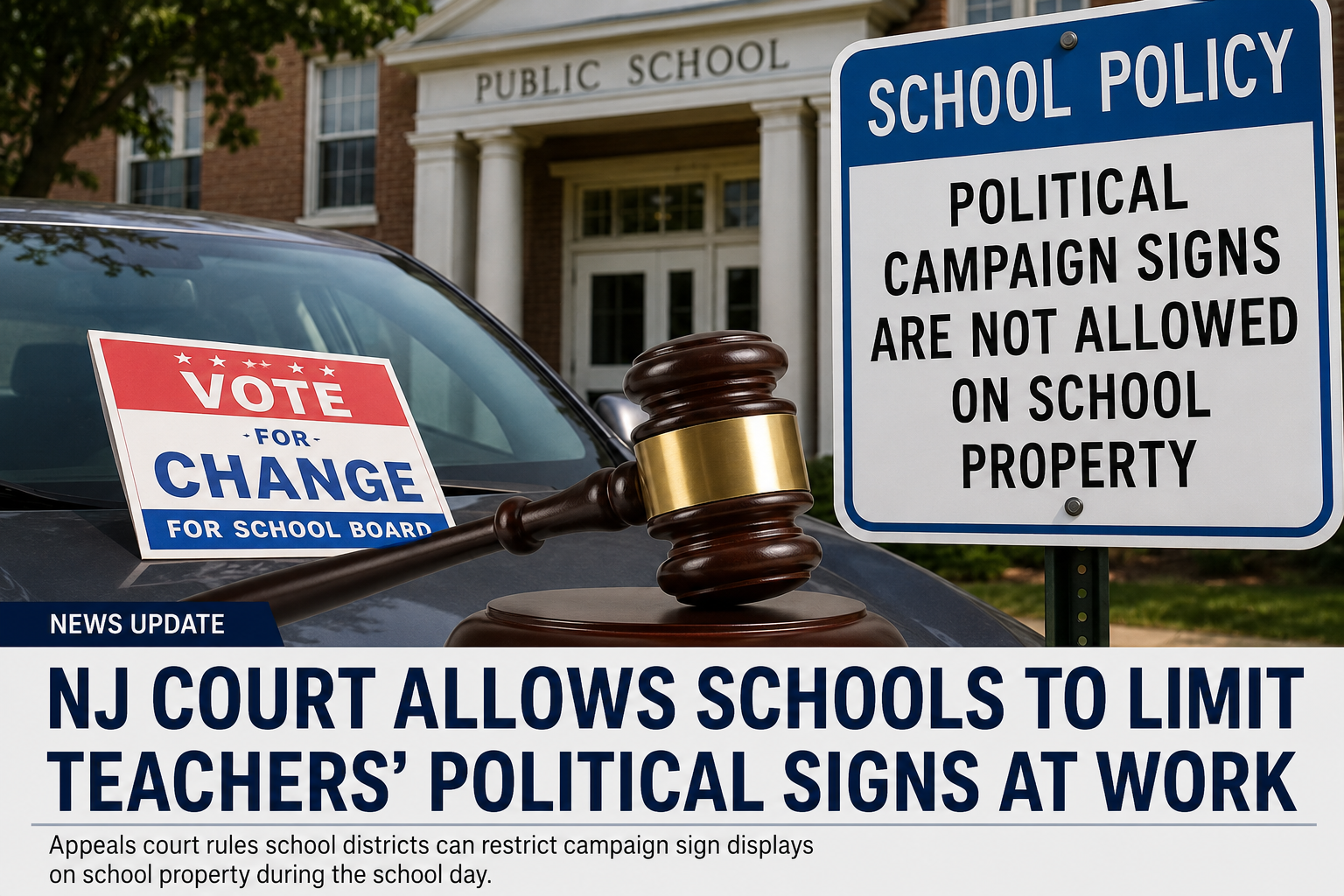
A New Jersey appeals court has ruled that public school districts can prohibit teachers from displaying political campaign signs on school property during the school day, saying the policy is a lawful way to maintain a politically neutral educational environment for students.
The decision reverses an earlier lower court ruling that found a policy adopted by the Ringwood Board of Education violated teachers’ constitutional rights. The appellate judges concluded that the district’s rule is limited in scope and applies only to political displays on school grounds while employees are at work, rather than restricting their broader political expression.
The legal dispute began in 2022 after school administrators discovered that several teachers had placed campaign lawn signs supporting local Board of Education candidates on the windscreens of their vehicles while parked at Ryerson Middle School. School officials determined that the displays conflicted with the district’s political activities policy and instructed employees to remove the signs.
The Ringwood Education Association challenged the policy, arguing that it was too broad and infringed on teachers’ First Amendment rights to free speech. In 2024, a Passaic County judge agreed with the union and ruled that the policy was unconstitutional.
However, the New Jersey Appellate Division reached a different conclusion after reviewing the case. A three-judge panel determined that the district’s policy is carefully focused on political activity taking place on school property, where students, parents, and community members may regularly see campaign messages.
According to the court, the policy does not prevent teachers from supporting political candidates, expressing personal opinions, taking part in election campaigns, or engaging in political discussions outside of school. Instead, it only limits the display of campaign materials while teachers are on school grounds during the workday.
The judges explained that public schools have a legitimate interest in maintaining a learning environment that remains free from visible political campaigning. They noted that allowing campaign signs in school parking lots could create the appearance that the school is endorsing a political candidate or encourage students to associate educational institutions with partisan activities.
The court compared teachers displaying campaign signs in school parking lots to members of the public placing political signs on school property, stating that both situations involve political messaging in a location controlled by the school district. For that reason, the judges found that school officials have the authority to restrict such displays without violating constitutional protections.
The ruling also emphasised that the district’s policy is narrowly tailored rather than a blanket ban on political speech. Teachers remain free to participate in political campaigns, attend rallies, volunteer for candidates, donate to campaigns, and display political signs at their homes or on private property outside the workplace.
In addition to resolving the dispute over campaign signs, the appeals court upheld the dismissal of a separate retaliation claim brought by former teacher Christopher Romano. Romano had argued that school officials took action against him after concerns were raised about Second Amendment decals displayed on his personal truck. The appellate judges agreed with the earlier dismissal of that claim, leaving the lower court’s decision intact.
The ruling provides additional legal guidance for school districts across New Jersey as they develop policies governing political activity in public schools. It reinforces the principle that while public employees retain their constitutional rights, school districts may establish reasonable workplace rules designed to preserve a politically neutral environment during school hours.
Legal observers say the decision could influence how other New Jersey school districts review or update their own policies concerning political expression on school property. Although the ruling applies to this specific case, it offers important clarification on the balance between employees’ free speech rights and a school district’s responsibility to maintain an impartial educational setting.
As election seasons continue to bring heightened political activity, the decision serves as a reminder that public schools may enforce reasonable restrictions on campaign displays within their facilities while still respecting employees’ rights to engage in political activities outside of work.
Sources:
- New Jersey Judiciary (Official)
- Ringwood Board of Education (Official)