
Former Chinese Premier Zhu Rongji Dies at 97, Leaving Behind a Major Economic Reform Legacy
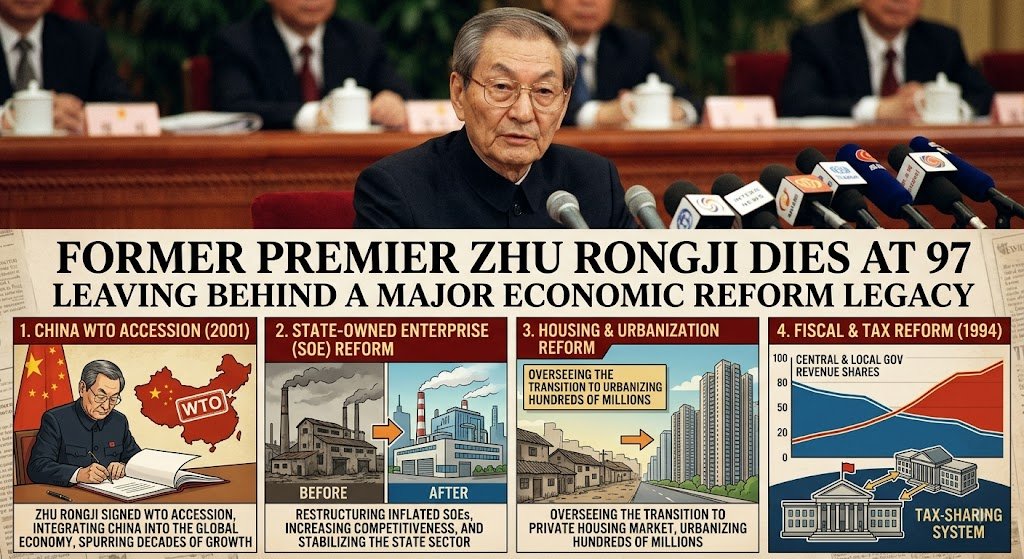
Zhu died in Beijing at about 11 a.m. local time on Wednesday, Aug. 12, 2026, after an illness. His death marks the end of the life of a political leader who played a major role in reshaping China’s economy at a time when the country was moving rapidly toward greater integration with global markets.
Although Zhu served as China’s premier for only five years, from 1998 to 2003, his period in office was closely linked with some of the country’s most significant economic reforms. His approach was often direct and demanding, and he became known for taking on difficult problems even when the changes caused political and social tensions.
Zhu was born in 1928 and graduated from Tsinghua University in Beijing. His early career was interrupted by political turmoil during the Cultural Revolution, when he was sent away from Beijing and required to perform manual work. He was later politically rehabilitated and gradually returned to government service.
His rise continued through the Chinese political system, eventually taking him to Shanghai, where he became mayor in 1987. During his time in Shanghai, Zhu gained a reputation as an energetic administrator who pushed infrastructure development and economic modernisation. His work in the city helped establish his reputation as a practical economic manager and contributed to his eventual move into China’s central government.
Zhu became vice premier in 1991 and was appointed premier in 1998 at the age of 69. As premier, he inherited an economy facing several major challenges, including financial risks, inefficient state-owned companies, inflation concerns and the broader pressure of adapting to a changing global economic system.
Rather than avoiding those problems, Zhu pursued aggressive reforms. One of the most difficult parts of his economic programme involved restructuring state-owned enterprises. Many government-owned companies were struggling financially and were considered inefficient. Zhu supported measures aimed at making those businesses more competitive and financially sustainable.
Those reforms came with a heavy human cost. Large numbers of workers lost their jobs as inefficient factories were closed, reorganised or privatised. The changes created hardship for millions of families and generated criticism from people who believed the reforms moved too quickly or placed too much pressure on workers.
At the same time, supporters of Zhu’s policies argued that the restructuring was necessary for China to build a more productive economy. The reforms helped prepare many parts of China’s economy for increased competition and greater participation in international trade.
Another major part of Zhu’s economic agenda was reforming China’s tax and financial systems. His government worked to strengthen central control over tax revenue and address weaknesses in the banking sector. These changes were intended to give the central government greater ability to manage the national economy and reduce financial instability.
Housing was also changing rapidly during Zhu’s years in government. Reforms helped move China away from an older system in which housing was largely provided through state-linked employment toward a system that allowed more people to purchase homes. The policy shift contributed to the development of China’s private housing market and played an important role in the country’s later real estate expansion.
Perhaps the most internationally significant achievement associated with Zhu was China’s entry into the World Trade Organization.
Zhu played a central role in the difficult negotiations that eventually helped China join the WTO in December 2001. The process required China to accept a number of commitments involving trade, investment and market access. Zhu personally participated in negotiations with foreign governments, including the United States, as Chinese officials worked to secure international support for membership.
China’s WTO membership became a major turning point in the country’s relationship with the global economy. It encouraged greater international trade and helped Chinese manufacturers become increasingly connected to overseas markets. In the years that followed, China’s exports and industrial production expanded rapidly, strengthening the country’s position in the world economy.
Zhu’s economic policies were not universally praised, however. Critics argued that some reforms created serious social costs and that certain decisions left difficult problems for later governments. The restructuring of state-owned companies, in particular, resulted in widespread layoffs and uncertainty for workers who had previously relied on state employment.
His leadership style also made him a distinctive figure in Chinese politics. Zhu was known for speaking bluntly and publicly criticising problems such as corruption, poor management and financial misconduct. His willingness to use unusually direct language helped create an image of a tough leader who was willing to confront difficult issues.
That style earned him popular nicknames, including “Boss” and “Madman Zhu”. While such descriptions reflected his reputation for being demanding, they also helped distinguish him from more cautious political figures.
Zhu’s career also reflected the complicated political history of modern China. He experienced political setbacks during the Cultural Revolution before returning to government service and eventually reaching one of the country’s highest offices. His journey from political hardship to the premiership was closely connected to the broader changes taking place in China after the reform era began.
By the time Zhu left office in 2003, China had undergone substantial economic changes. The country was increasingly connected to international markets, its industrial base was expanding, and reforms had altered the role of state-owned businesses and housing in everyday economic life.
The full impact of Zhu’s policies became even clearer in the years after his retirement. China continued to experience rapid economic growth and eventually became the world’s second-largest economy. While it would be inaccurate to attribute that transformation to one individual, Zhu’s reforms formed an important part of the economic changes that took place during that period.
His legacy has remained a subject of discussion among economists, political observers and historians. Supporters remember him as a reformer who confronted problems that other leaders might have avoided. Critics point to the social consequences of restructuring and argue that some of his policies produced difficult long-term effects.
Zhu himself remained largely out of the political spotlight after leaving office. His speeches and remarks from his years in government later attracted renewed attention, particularly because they addressed issues such as corruption, government debt, financial risks and economic management.
His death therefore represents more than the passing of a former government official. Zhu Rongji belonged to a generation of Chinese leaders who oversaw the country’s transition from a relatively closed economic system toward deeper participation in the global economy.
For many observers, his most lasting legacy will be the willingness to pursue difficult economic reforms during a period when China was preparing for a much larger role in international trade. Those reforms affected businesses, workers, government institutions and ordinary households, making Zhu’s time in office an important chapter in China’s modern economic history.
Zhu Rongji was 97 when he died in Beijing on Aug. 12, 2026. His career remains closely associated with China’s economic reform period and with the major policy decisions that helped shape the country’s path into the global economy.
Sources
Reuters, “Zhu Rongji, Chinese premier who cajoled economy into modern era, dies at 97″, Aug. 12, 2026.
Xinhua News Agency, official report on the death of former Chinese Premier Zhu Rongji, Aug. 12, 2026.
Ministry of Foreign Affairs of the People’s Republic of China, official historical records concerning Premier Zhu Rongji and China’s international economic relations.
Ministry of Foreign Affairs of the People’s Republic of China, 2003 Government Work Report delivered by Premier Zhu Rongji.