Alex Rodriguez Questions Whether the Yankees Did Enough to Build Around Aaron Judge
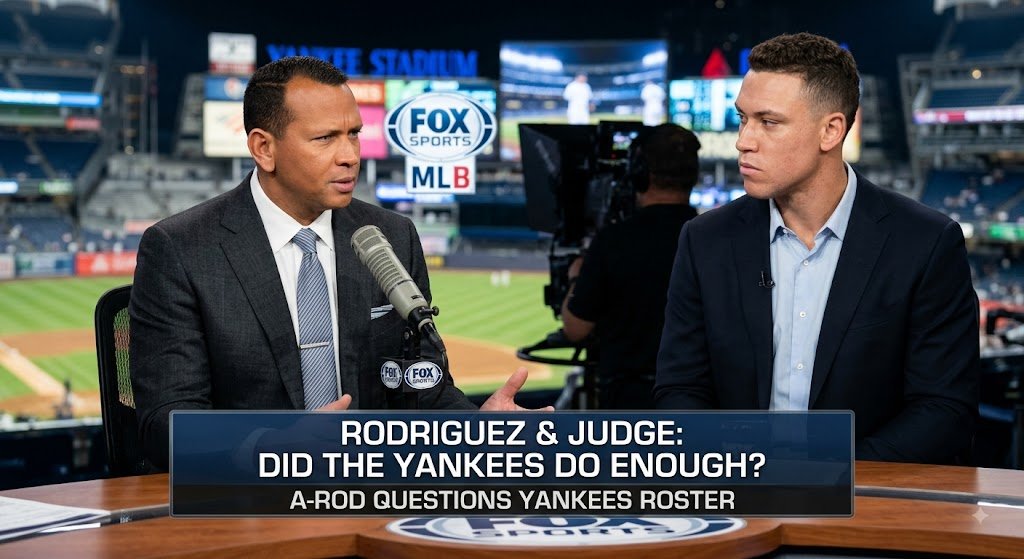
Alex Rodriguez believes the New York Yankees may have missed an important opportunity to strengthen their roster during the 2026 trade deadline.
Rodriguez, who spent part of his career in New York and remains an outspoken Yankees supporter, recently questioned whether the organisation should have been more aggressive with its deadline moves. His concern is not simply about the players the Yankees acquired but whether the team did enough to maximise the remaining prime years of superstar Aaron Judge.
The Yankees entered the Aug. 3 trade deadline with major questions surrounding their offence. Judge had been sidelined since May 31 because of a fractured right rib, leaving New York without the centrepiece of its lineup for much of the season. The club eventually added first baseman Luis Garcia Jr and outfielder Heliot Ramos but did not make the kind of blockbuster move that some expected. Judge has since progressed to light physical activity, although his exact return date remains uncertain.
For Rodriguez, the bigger issue is the opportunity in front of the Yankees. Judge is scheduled to turn 35 during the 2027 season, and Rodriguez believes the organisation should be thinking beyond simply getting through the current season. His argument is that a player of Judge’s calibre deserves to be surrounded by as much quality as possible while he remains one of baseball’s most influential hitters.
That does not mean the Yankees completely ignored their weaknesses. Garcia Jr and Ramos gave the offence additional options, while the emergence of young shortstop George Lombard Jr also provided the organisation with another potential piece for the future. Ramos, in particular, addressed the club’s need for a right-handed bat and was under team control beyond the current season.
Still, Rodriguez believes the Yankees could have used the deadline to address two specific areas: consistent contact hitting and additional pitching depth.
One player Rodriguez viewed as an interesting fit was Luis Arraez. The left-handed hitter had been one of baseball’s most reliable contact hitters and was traded by the San Francisco Giants to the Philadelphia Phillies at the deadline. Arraez has built his reputation around putting the ball in play and maintaining a high batting average rather than relying heavily on home runs. He was also having one of his better defensive seasons at second base in 2026.
The Yankees ultimately did not acquire Arraez. Their existing roster also created a complicated fit because Jazz Chisholm Jr. was already playing second base, meaning adding another player at that position would have required the club to make further changes. MLB’s analysis before the deadline also pointed to that roster complication when considering a possible Arraez-to-New-York scenario.
The offensive concern becomes more noticeable when Judge is unavailable.
Judge’s absence has left the Yankees with a lineup that can become heavily dependent on left-handed hitters. That makes it easier for opposing pitchers to attack the lineup with favourable matchups, particularly when several consecutive hitters have similar handedness.
The Yankees were already aware of that problem before the deadline. MLB reported that the club was looking for right-handed offensive help as injuries to Judge, Cody Bellinger and Giancarlo Stanton created additional pressure on the lineup. Ramos was ultimately one of the players brought in to help address that imbalance.
Rodriguez’s other concern involves the pitching staff.
On paper, the Yankees have plenty of reasons to feel confident about their rotation. Gerrit Cole, Max Fried and young right-hander Cam Schlittler give the club significant starting-pitching talent. The bigger question is what happens over a long season if the offence continues to struggle.
A team that regularly plays close, low-scoring games places greater pressure on its bullpen. Instead of protecting leads with comfortable margins, relievers may repeatedly be asked to work in high-pressure situations. Over several weeks and months, that workload can become a serious issue, particularly when a team is trying to remain competitive late in the season.
The Yankees did explore pitching options before the deadline. Mason Miller was among the high-profile relievers connected to New York, while the club was also linked to several other potential targets. However, reports indicated that teams seeking a deal with New York often wanted Lombard, one of the organisation’s most important young prospects, as part of the return. The Yankees ultimately chose not to make that type of trade.
That decision highlights the difficult balance facing general manager Brian Cashman.
Going all-in at the deadline can improve a team’s chances of winning immediately, but the cost can be significant. Trading a highly regarded prospect may solve one problem for the current season while creating another for the future. Keeping that prospect, meanwhile, can leave the major-league roster short of the help it needs right now.
The Yankees’ relatively quiet deadline, therefore, does not necessarily mean the front office failed to recognise its weaknesses. The organisation had reportedly been involved in discussions for several impact players, but the market was expensive and some potential deals required giving up significant young talent. Adley Rutschman, Tarik Skubal and Mason Miller were among the major names connected to the Yankees in the weeks surrounding the deadline.
There is also another factor that makes the Yankees’ deadline strategy difficult to judge: Judge’s health.
Before his injury, Judge remained one of the most important offensive players in the sport. He had 17 home runs, 38 RBIs and a .907 OPS through 59 games before going on the injured list. His eventual return could dramatically change how the Yankees’ lineup looks.
Judge recently took another step in his rehabilitation by resuming light physical activity, including outdoor running and upper-body resistance work. The Yankees have been cautious, and his progression is being guided by how he responds rather than by a fixed return date.
That creates an important question for the organisation: how much should a front office spend or sacrifice for a championship push when its best player is still working his way back?
If Judge returns healthy and the new additions perform well, the Yankees could look back at the deadline differently. Garcia Jr. and Ramos do not need to become superstars for the moves to work. They simply need to provide meaningful production around a lineup that has struggled without its captain.
But if the offence remains inconsistent and the bullpen becomes overworked, Rodriguez’s criticism could gain more weight as the season moves toward September.
The situation also extends beyond 2026. Judge’s age makes the Yankees’ championship window an important consideration. He signed a nine-year contract with New York before the 2023 season, keeping him under contract through 2031. The organisation, therefore, has several seasons remaining with its biggest star, but the value of those seasons depends heavily on how effectively the club surrounds him with reliable talent.
For Yankees fans, that is likely the heart of Rodriguez’s argument. The question is not whether the Yankees have talented players. They clearly do. The question is whether the roster is strong enough in enough areas to turn that talent into another deep postseason run.
The Yankees now have to live with the decisions made at the deadline. The focus will shift toward getting Judge back, integrating the new players, protecting the pitching staff and finding enough offence to support the rotation.
If those pieces come together, the decision to preserve the farm system and avoid a major blockbuster could prove sensible. If they do not, the debate over whether New York should have pushed harder will only become louder.
For now, Rodriguez’s comments put the pressure where it has traditionally been in New York: on the front office to build a championship-calibre team around its biggest star. With Judge approaching the latter stages of his prime, every season carries greater importance, and the Yankees will have to determine whether patience or aggression gives them the better chance to finally return to the top of baseball.
Sources
- Major League Baseball — Yankees trade deadline coverage and 2026 trade targets.
- Reuters — Aaron Judge’s August 2026 rehabilitation update.
- Major League Baseball — Luis Arraez trade-deadline analysis.
- The Wall Street Journal — Luis Arraez’s 2026 season and trade to Philadelphia.
- New York Post — Analysis of the Yankees’ 2026 trade-deadline strategy.