Philadelphia Eagles Face Critical Offensive Line Transition Ahead of 2026 NFL Draft
The Philadelphia Eagles are heading into the 2026 NFL Draft with a clear and urgent focus on strengthening their offensive line, as long-term concerns across the unit continue to grow. While the team has multiple areas to evaluate, the biggest issue remains the stability and future of its offensive front, which has been a key factor in both past success and recent struggles.
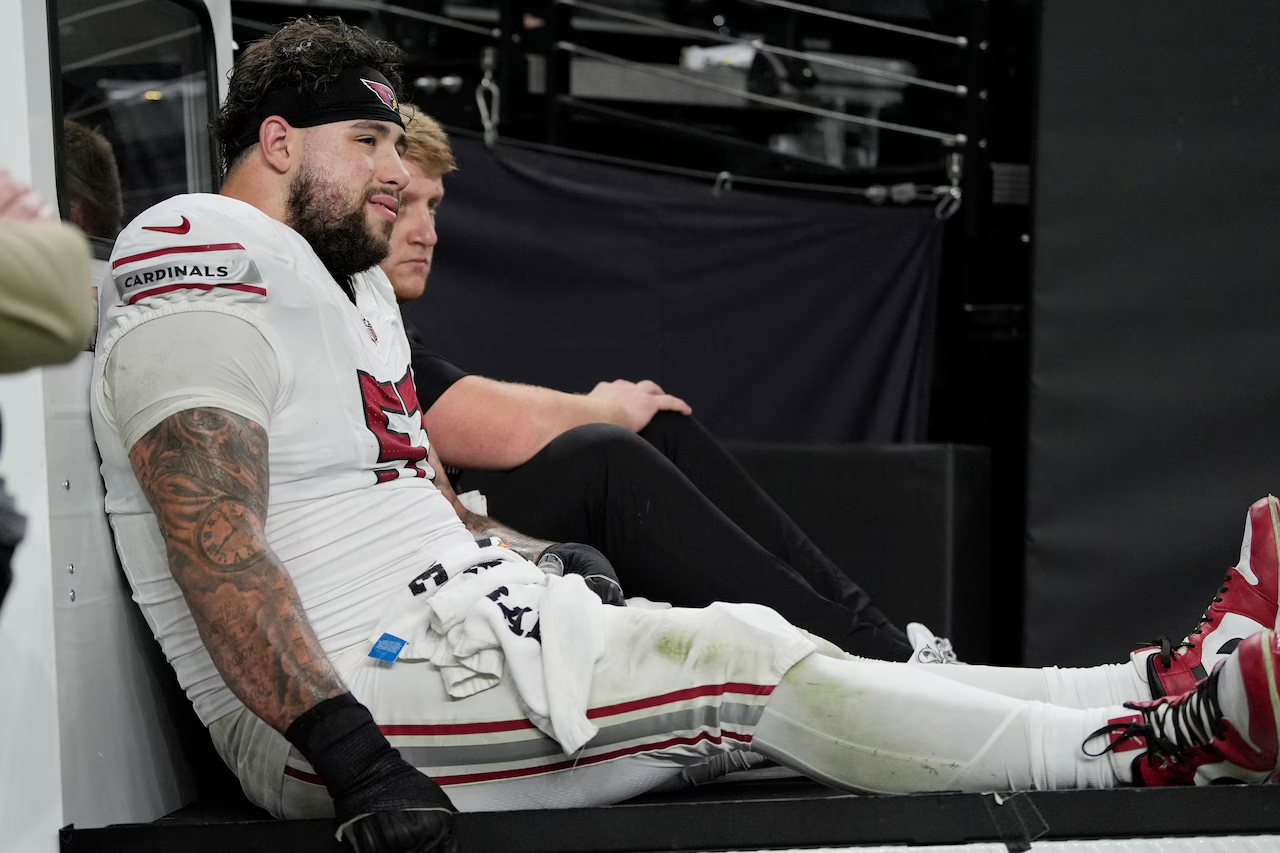
Reports suggest that the Eagles are preparing for possible major changes across several starting positions in the coming seasons. Left guard Landon Dickerson reportedly considered retirement due to ongoing injury concerns and has already adjusted his contract structure in a way that could benefit the team financially if he steps away in the near future. At right guard, Tyler Steen is set to reach free agency after the 2026 season, raising uncertainty about his long-term role.
At right tackle, veteran Lane Johnson, now 35 years old, is expected to retire within the next few years, which would leave a significant leadership and performance gap. Meanwhile, center Cam Jurgens has dealt with recurring back and knee injuries over the past two seasons, limiting consistency. On the left side, Jordan Mailata remains relatively more stable in terms of injuries, but his performance level reportedly declined during the 2025 season.
These combined factors have created a situation where the Eagles may soon face a near-complete reshaping of their offensive line. Analysts suggest that as many as three starting positions could open by 2027 if current trends continue, making this draft and the next offseason extremely important for long-term planning.
The impact of the offensive line on Philadelphia’s overall performance has been clearly visible. In the 2025 season, the unit struggled to maintain the same level of dominance it once had, contributing to a noticeable decline in offensive production and an early playoff exit. This stands in sharp contrast to the 2024 Super Bowl-contending season, when the offensive line played a major role in creating running lanes and controlling games on the ground.
A strong running game, particularly built around Saquon Barkley’s breakout 2,000-yard season, previously allowed quarterback Jalen Hurts to operate with less pressure and greater efficiency. Without consistent blocking up front, however, the offense loses rhythm, and the passing game becomes less effective. This dependency highlights why rebuilding the offensive line is not just a priority but a necessity for maintaining long-term competitiveness.
With the 2026 NFL Draft approaching, the Eagles are expected to target multiple offensive linemen across the early rounds. The draft class offers a mix of high-upside tackles and powerful interior linemen who could either develop behind veterans or step into starting roles sooner than expected.
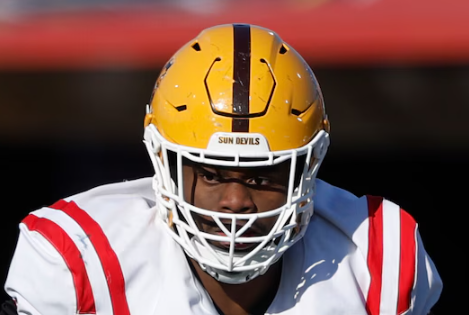
Among the top first-round prospects is Monroe Freeling from Georgia, a physically gifted offensive tackle known for his size, athletic movement, and ability to operate in open space. Another potential option is Max Iheanachor from Arizona State, who brings strong pass protection potential but requires technical refinement.
Alabama’s Kadyn Proctor also stands out as a high-risk, high-reward prospect due to his rare size and strength but inconsistent pass protection and conditioning concerns. Clemson’s Blake Miller offers a more polished and pro-ready profile, with extensive college experience and strong pass-blocking skills, though he still needs to improve core strength.
Utah’s Caleb Lomu is another name under consideration, though a position switch to the right side may be required at the professional level, which could take time to adjust. On the interior, Penn State’s Vega Ioane is viewed as one of the strongest overall prospects in the class, combining power, physicality, and a high floor as both a run and pass blocker, though acquiring him may require an aggressive trade-up.
For mid-round value, Oregon’s Emmanuel Pregnon and Georgia Tech’s Kaylen Rutledge are seen as potential long-term solutions at guard, both bringing physical playing styles suited for NFL-level trench battles. Texas A&M’s Chase Bisontis is also part of the group of interior linemen expected to generate interest as teams look to reinforce depth.
Overall, the Eagles appear to be entering a transitional phase where proactive drafting is essential. With multiple key veterans approaching contract endings, injuries, or possible retirement, the organization’s ability to rebuild the offensive line efficiently will likely determine how competitive the team remains in the coming seasons.
If Philadelphia succeeds in strengthening this unit through the draft, it could restore the identity that once powered deep playoff runs and a championship season. If not, the team risks entering a period of instability that could significantly impact its offensive effectiveness.
Sources:
NFL Draft team reports, ESPN analysis, NFL Network reports, Philadelphia Eagles roster and performance data from 2024–2025 seasons, College football scouting evaluations.