
New Jersey Court Ruling Strengthens Eviction Protections for Public Housing Tenants
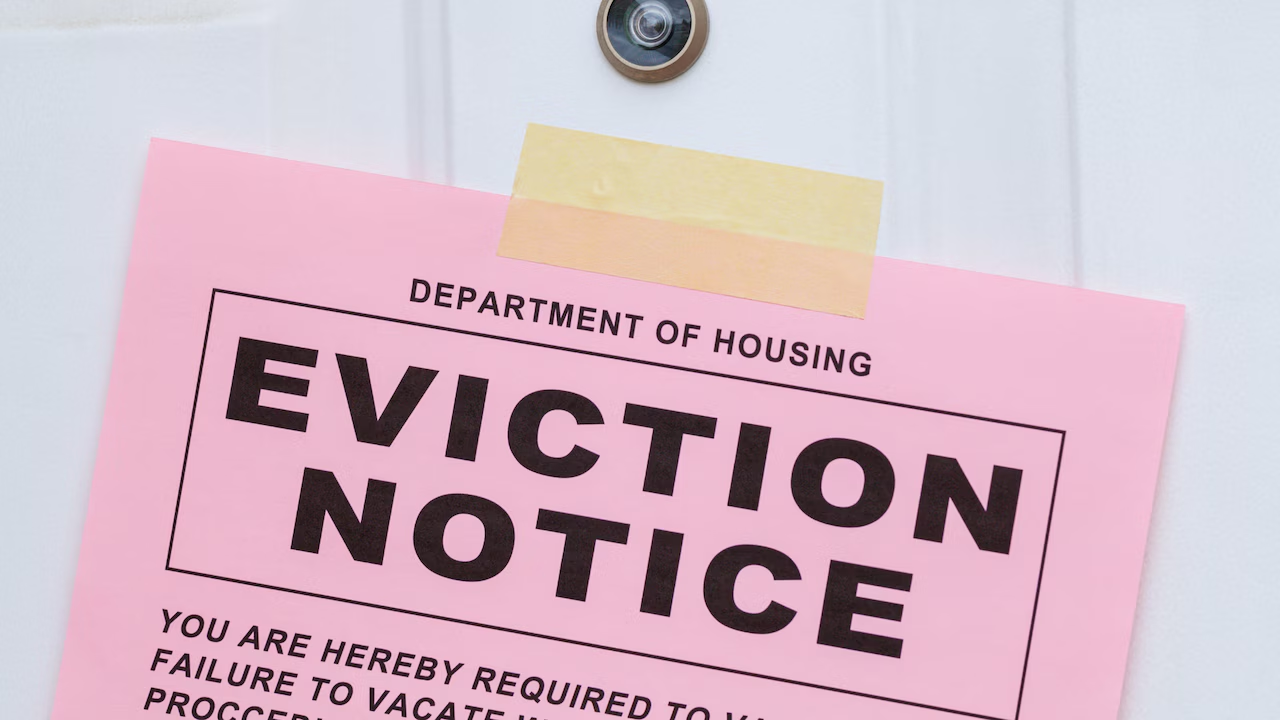
A New Jersey appellate court has delivered an important ruling for residents living in publicly subsidised housing, making clear that a tenant cannot automatically lose their home simply because they failed to follow the terms of a settlement agreement.
The decision came from a case involving Zalayah Hunt, a single mother living with her 4-year-old daughter in housing operated by the Phillipsburg Housing Authority. Hunt had been facing eviction after the housing authority accused her of violating a probation agreement that required her to attend meetings and provide information needed to confirm her continued eligibility for housing assistance.
On July 23, 2026, the New Jersey Superior Court, Appellate Division, reversed the judgement that had allowed the housing authority to remove Hunt from her apartment. The court said a settlement agreement cannot replace the legal requirements that must normally be met before a tenant can be evicted under New Jersey law.
The ruling is significant because it establishes that public housing authorities cannot simply turn a broken settlement agreement into an automatic eviction. A court must still determine whether the tenant’s conduct meets the legal standard for eviction.
For thousands of New Jersey residents who depend on public housing and other forms of rental assistance, the decision reinforces an important principle: receiving subsidised housing does not mean giving up basic tenant protections.
Hunt became a tenant of the Phillipsburg Housing Authority in December 2021. According to the appellate court’s published opinion, she was classified as a “zero-income” tenant and was paying the minimum monthly rent of $50 under her housing arrangement.
Her housing assistance required her to provide information and documents periodically so the housing authority could determine whether she remained eligible. Public housing authorities have an important responsibility to verify household income and other eligibility information because federal housing assistance is intended for households that meet programme requirements.
The U.S. Department of Housing and Urban Development explains that public housing authorities determine eligibility using factors such as annual income, family status and other federal requirements. HUD also requires housing authorities to conduct income and household reviews as part of administering assisted housing programmes.
The dispute involving Hunt developed over several years. Court records show that the Phillipsburg Housing Authority had concerns about missed appointments, delayed paperwork and other difficulties connected to her required recertification process.
In 2025, the situation escalated. After several notices and administrative proceedings, the housing authority filed an eviction complaint against Hunt in September.
Instead of immediately proceeding to a full trial, Hunt and the housing authority reached a settlement in November 2025. The agreement placed Hunt on a six-month probation period.
Under the agreement, Hunt was required to attend all required meetings with the housing authority and provide a reason if she needed to reschedule. The agreement stated that the housing authority could report a breach to the court if she failed to follow those requirements.
The housing authority later alleged that Hunt violated the agreement several times by missing meetings or failing to adequately explain why she needed to reschedule.
That disagreement eventually led to an eviction order.
The trial court enforced the possession judgement without first making a separate finding that Hunt’s conduct amounted to a legally sufficient violation under New Jersey’s Anti-Eviction Act.
That distinction became the central issue before the appellate court.
The appeals judges concluded that the settlement could not eliminate protections provided by state law. In practical terms, a tenant cannot sign a settlement agreement that gives a housing authority greater power to evict than the law itself allows.
The court explained that when an eviction is challenged, the landlord or housing authority still has to establish the required legal grounds. A settlement agreement cannot shift that responsibility entirely onto the tenant or give the housing authority unilateral authority to decide that a breach automatically justifies eviction.
This does not mean that public housing tenants can ignore their leases or housing authority requirements.
Residents still have responsibilities. Housing authorities must be able to verify income, household information and eligibility, and tenants who repeatedly fail to provide required information can face serious consequences.
The appellate decision instead focuses on proportionality and due process. The court emphasised that the ultimate loss of a home should not automatically follow from every missed appointment or technical violation, particularly when the underlying issue may still be corrected.
That point was particularly important in Hunt’s case.
According to the court’s opinion, Hunt indicated about a month before the March 2026 hearing that she was prepared to meet with housing authority staff and provide the outstanding documents. The housing authority declined to meet with her and would not accept the documents at that point.
The appellate panel concluded that, under the circumstances presented in the case, Hunt should have been given an opportunity to cure the problem.
The judges therefore reversed and vacated the judgement for possession and the warrant for her removal. The case was sent back to the trial court for further proceedings.
Importantly, the ruling does not declare that Hunt is permanently protected from eviction or that she has automatically established her eligibility for housing assistance.
The appellate court specifically left those questions open.
The housing authority can still pursue the matter in the lower court. However, if it does so, it must satisfy the requirements of New Jersey’s eviction law and establish a legally recognised basis for removing her from the home.
That distinction matters because public housing is different from an ordinary private rental dispute in several respects. Housing authorities administer programmes supported by federal funding, and residents must comply with programme rules. At the same time, public housing tenants remain tenants and are entitled to protections provided by state law.
New Jersey’s Anti-Eviction Act generally requires a landlord to establish good cause before removing a residential tenant in situations covered by the law. The appellate court’s ruling makes clear that this requirement cannot simply be weakened through a settlement agreement.
The decision could therefore affect housing authorities across New Jersey that use similar probation or settlement arrangements.
The case is also a reminder of why housing disputes can become complicated quickly. A missed appointment may appear minor on its own, but for someone receiving income-based assistance, failing to complete a required recertification can raise questions about continued eligibility.
Federal housing rules require public housing agencies to verify information from assisted households. HUD guidance specifically recognises additional scrutiny for households reporting no income because agencies need to make sure assistance continues to go to people who qualify.
That verification process serves an important public purpose. Public housing is a limited resource, and housing authorities must ensure that available units and assistance are provided to eligible residents.
But the New Jersey appellate court drew a line between enforcing those requirements and treating every failure as an automatic reason for eviction.
The court stressed that eviction is an extremely serious consequence. Losing a home can disrupt a family’s employment, schooling, finances and overall stability. In Hunt’s case, the potential removal also involved her young daughter.
The decision therefore places greater emphasis on having a judge examine the circumstances before the most severe remedy is imposed.
The ruling also highlights the importance of allowing tenants to correct problems when the circumstances permit it. A tenant who has failed to submit paperwork may still be able to provide it later. A missed meeting may sometimes be rescheduled. Whether a violation is serious enough to justify eviction depends on the facts and the applicable law.
For public housing residents throughout New Jersey, the practical lesson is not that housing rules can be ignored. Instead, residents should take notices, recertification requests, appointments and requests for documentation seriously and respond as quickly as possible.
Anyone facing an eviction proceeding should also understand that a settlement agreement does not necessarily erase statutory tenant protections. The Hunt decision establishes that courts must still apply the legal requirements governing eviction.
The ruling is particularly notable because Hunt represented herself in the appeal after initially having legal representation during the settlement process. Her case ultimately reached the appellate court after she faced removal from her home.
For now, her eviction judgement has been vacated, and the case will return to the trial court.
The broader impact, however, extends beyond one family in Phillipsburg. The appellate court’s published decision establishes a legal precedent for similar cases in New Jersey. Housing authorities may continue to require tenants to comply with programme rules and settlement terms, but they cannot treat a breach of those agreements as an automatic substitute for proving the legal grounds necessary for eviction.
New Jersey’s public housing system serves residents who often have few affordable alternatives if they lose their housing. The court’s decision does not eliminate the responsibilities that come with receiving housing assistance, but it reinforces the idea that those responsibilities must be enforced within the protections provided by state law.
For tenants, the message is straightforward: a housing authority may enforce legitimate programme requirements, but the loss of a home cannot be based solely on an authority’s declaration that a settlement agreement was broken. When the right to remain in a home is at stake, the law still requires judicial scrutiny and a legally sufficient basis for eviction.
As Hunt’s case moves back to the lower court, the dispute will continue to determine whether the housing authority can establish grounds for eviction under the applicable law. The appellate ruling, however, has already clarified one important point for New Jersey’s public housing system: a probation agreement cannot become a shortcut around the state’s tenant protections.
Sources
New Jersey Superior Court, Appellate Division, Phillipsburg Housing Authority v. Zalayah Hunt, Docket No. A-2424-25, decision issued July 23, 2026.
U.S. Department of Housing and Urban Development, New Jersey housing assistance and public housing information.
U.S. Department of Housing and Urban Development, Public Housing Occupancy Guidebook, including guidance concerning zero-income households and income reexaminations.
New Jersey Department of Community Affairs, New Jersey Guide to Affordable Housing and information concerning public housing authorities.