New Jersey Takes New Steps to Put Children’s Safety Ahead of Social Media Engagement
New Jersey is moving ahead with a major expansion of protections for children who use social media and other online services, putting more attention on privacy, addictive platform features and the way technology can affect young people’s health.
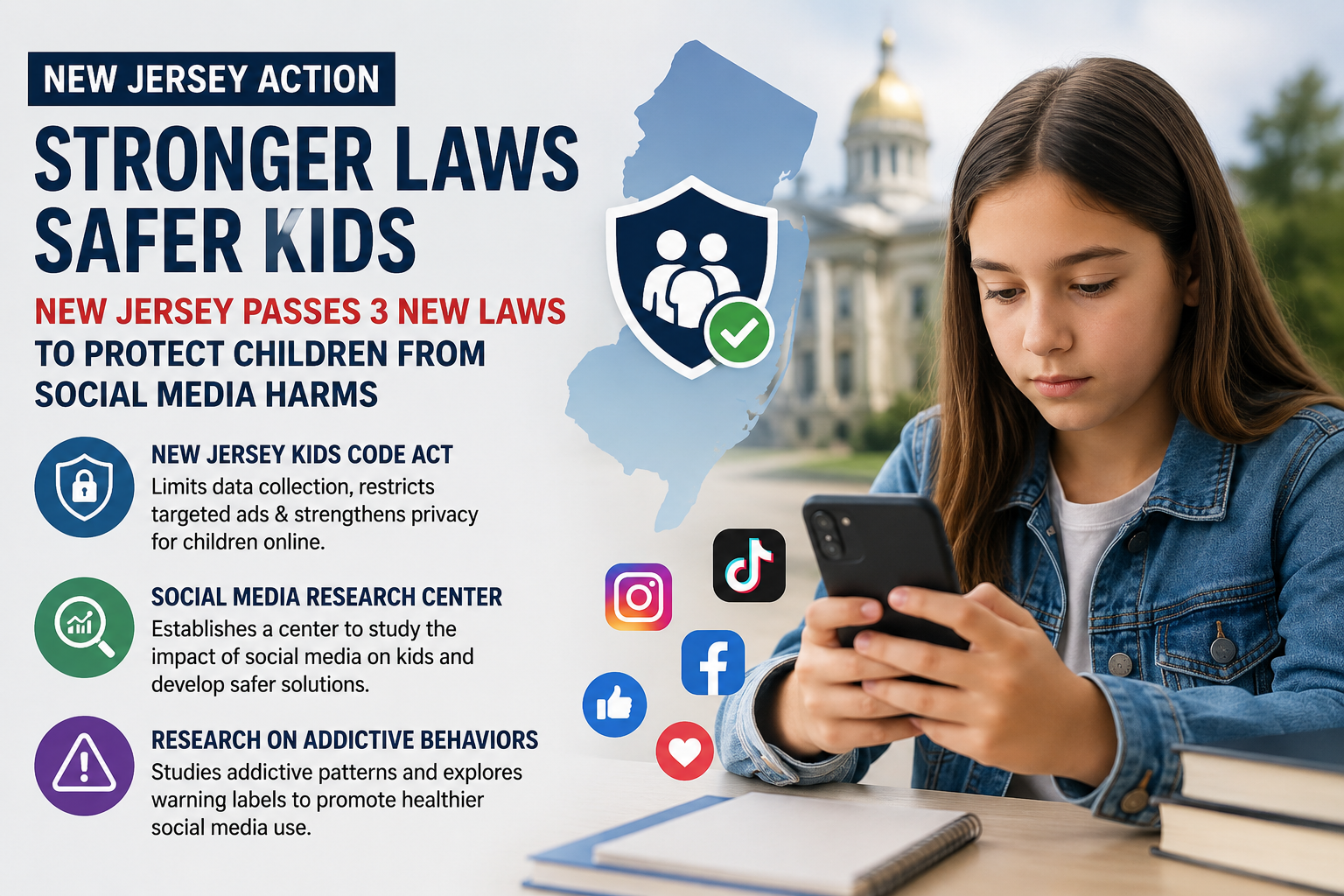
The state legislature passed three measures on June 30 that form a broader approach to children’s online safety. The package includes the New Jersey Kids Code Act, legislation creating a Social Media Research Center at a public college or university, and a separate measure directing that centre to study addictive social media behaviours and possible warning labels. Official legislative records show all three measures cleared the legislature.
The measures come as concerns continue to grow about how much time children spend online and how social media platforms are designed to keep users engaged. New Jersey Gov. Mikie Sherrill has made youth online safety and mental health a major part of her administration’s agenda. Earlier this year, she created the Office of Youth Online Mental Health Safety and Awareness within the New Jersey Department of Health through Executive Order No. 6. The office was tasked with coordinating state efforts involving children, technology and online safety.
The first major piece of the legislative package is the New Jersey Kids Code Act, formally described in the legislation as an Age-Appropriate Design Code. The measure is designed to change how covered online services handle accounts belonging to children and minors.
Under the legislation, online platforms covered by the law would have to set the strongest available privacy protections by default for covered children and minors. Among other requirements, platforms would have to limit the ability of adults to view minors’ content or communicate with them unless the minor has clearly permitted that interaction. Platforms would also have to restrict the display of a minor’s location, hide certain information about a minor’s connections and disable search-engine indexing of the minor’s account by default.
The law also takes aim at some of the design choices that can encourage children to remain on a platform for longer periods. Covered services would be restricted from using certain dark patterns, a term commonly used for digital designs that can manipulate users into making choices they might not otherwise make.
Notifications would also face new restrictions. The legislation says covered platforms may not send notifications to children or minors by default and would prohibit certain notifications during overnight hours. On weekdays during the school year, additional limits would apply during typical school hours.
Data privacy is another major part of the legislation. Covered online services would generally be required to collect and retain only the personal information needed to provide the specific service a minor is knowingly using. The legislation also places limits on using a minor’s personal data for purposes unrelated to why it was collected.
The rules address targeted advertising as well. The legislation prohibits covered online services from facilitating targeted advertising to covered minors and places additional restrictions on how personal information can be used by recommendation systems.
Another important feature is that minors would receive easier ways to request that their accounts be unpublished or deleted. The legislation also establishes mechanisms for reporting harms experienced on covered online services.
The second measure creates a social media research centre at a four-year public institution of higher education in New Jersey. The exact institution is to be selected by the state’s higher education authorities in coordination with the Office of Youth Online Mental Health Safety and Awareness.
The centre is intended to provide research rather than simply set policy. Its work would include examining how social media affects New Jersey residents, studying potential mental, physical and behavioural health effects, developing policy recommendations and creating online courses or training materials on safer social media use that could be made available to schools at no cost.
The centre could also receive and conduct research supported by grants, gifts and other funding sources. State agencies could submit research questions to the centre, while information shared for research would have to be handled under applicable privacy and security requirements.
The state has already set aside funding for this effort. New Jersey’s FY 2027 budget includes $500,000 for a social media research centre, while $125,000 was allocated to the Office of Youth Online Mental Health Safety and Awareness within the Department of Health.
The third measure gives the research centre a more specific assignment: studying what lawmakers call “addictive social media behaviours” among children and minors.
That research would examine how social media use affects public health and whether warning labels could reduce harmful or excessive use. The centre would also study when and how warning labels might be displayed, including when a young person creates an account, accesses a service, reaches a certain amount of daily use or shows behaviour identified as potentially addictive.
The legislation also calls for research into disclaimers that could appear in advertisements for online services and whether those warnings can help reduce problematic social media behaviour among young users.
The research requirement is significant because New Jersey is not simply relying on parents and schools to determine whether particular online features are harmful. The state is creating a structure intended to gather evidence and use that information when developing future policies.
The legislation directs the research centre to produce a report with its findings and recommendations. The state Department of Health would then review those findings and could consider additional rules based on the research.
New Jersey’s approach follows growing federal concern about social media and youth health. The U.S. Surgeon General has previously said that up to 95% of teenagers ages 13 to 17 report using a social media platform and that adolescents who spend more than three hours a day on social media face roughly twice the risk of experiencing certain mental health problems, including symptoms of depression and anxiety. At the same time, federal health officials have emphasised that the evidence is complex and that social media can provide benefits as well as risks.
That distinction matters. The new New Jersey measures do not amount to a blanket ban on social media for children. Instead, the laws focus on how online platforms are designed, what information they collect, how they use minors’ data, how they communicate with young users and how potential harms can be studied.
The state’s policy also reflects a broader shift in the debate over children and technology. Instead of placing the entire responsibility on parents to monitor every app, notification and recommendation, New Jersey is seeking to place more responsibility on the companies operating the platforms.
For parents, the changes could eventually mean stronger privacy settings and fewer opportunities for strangers or advertisers to interact with children through covered online services. For technology companies, the requirements could mean changes to account settings, recommendation systems, notifications, advertising practices, data collection and reporting.
The impact will depend heavily on how the laws are implemented and enforced. Online platforms operate across state lines, and companies may have to make technical changes to determine which users are minors, apply different settings and comply with New Jersey-specific requirements.
There is also a broader question about how effective these protections will be in practice. Social media technology changes quickly, and new features can appear long before regulators have time to study their effects. That is one reason the research component of New Jersey’s approach could become important.
Gov. Sherrill has already made online safety a priority. On her first day in office, Executive Order No. 6 directed state agencies to prioritise children’s mental health when dealing with technology, smartphones, the internet and social media. The order also called for agencies to review existing policies and identify ways to encourage healthier and age-appropriate internet and social media use.
New Jersey’s latest measures therefore represent another step in a policy effort that began earlier in the year. The state is attempting to address the issue from several directions at once: stronger privacy protections, safer platform design, independent research and greater attention to potentially addictive features.
For families, the immediate message is not that social media is automatically harmful or that children should be removed from the internet. Rather, New Jersey is trying to make online services safer by default while gathering more information about which features and patterns of use may create the greatest risks.
The coming months will show how these measures translate from legislation into actual changes on social media platforms. The selection of the research centre, development of its research programme and implementation of the new online safety requirements will be closely watched by parents, schools, technology companies and policymakers.
As social media continues to play a major role in how young people communicate, learn and spend their free time, New Jersey is betting that protecting children will require more than parental controls. The state is building a system that puts privacy, safety and evidence-based research closer to the centre of the online experience.
Sources
New Jersey Legislature — Bill A4015, New Jersey Kids Code Act.
New Jersey Legislature — Bill A4014, Social Media Research Center.
New Jersey Legislature — Bill S3412, research concerning addictive social media behaviours.
Office of the Governor of New Jersey — Executive Order No. 6 and Kids’ Online Safety Agenda.
State of New Jersey — FY 2027 Appropriations Act.
U.S. Department of Health and Human Services, Office of the Surgeon General — Social Media and Youth Mental Health Advisory.