
Trump Reveals New Security Details Behind Planned White House Ballroom Expansion
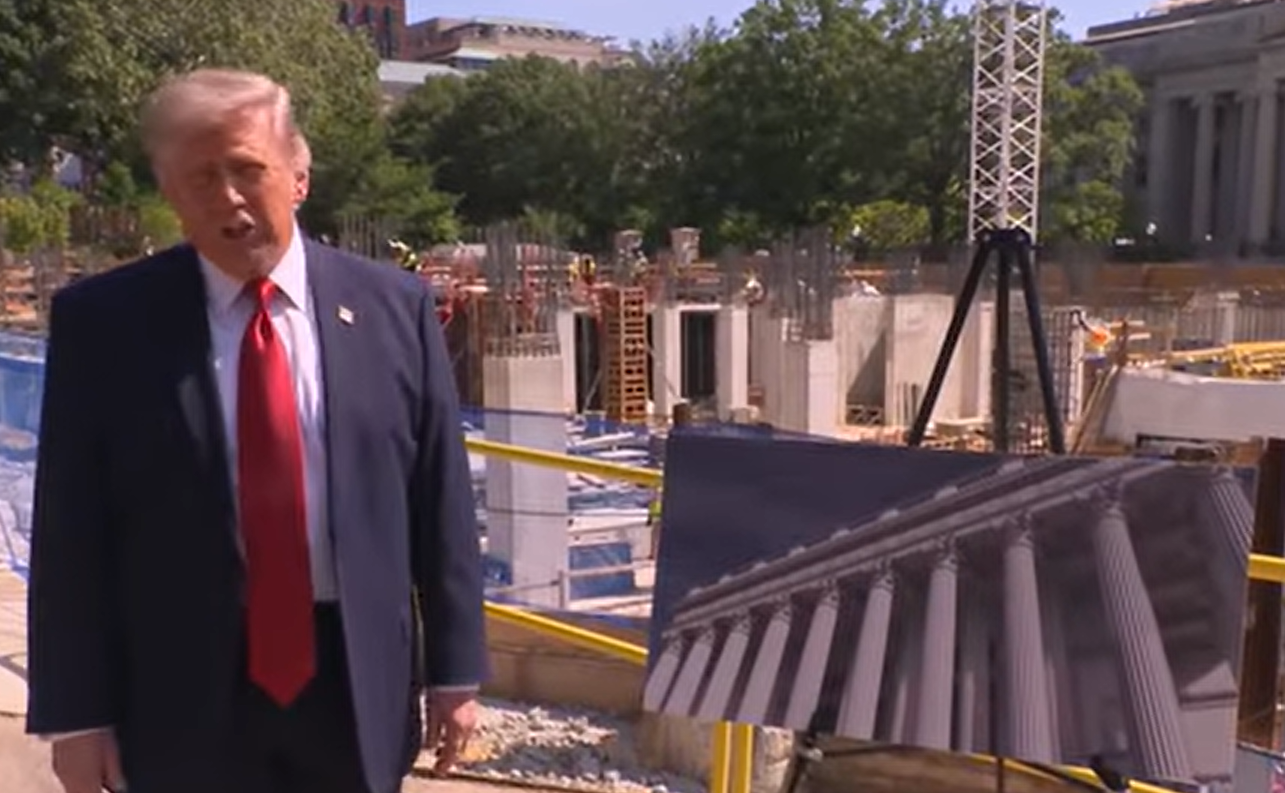
President Donald Trump on Tuesday shared new details about the security features planned for the proposed White House ballroom project, describing the future structure as a major protective addition for both the White House complex and Washington, D.C.
During a media tour of the construction site, Trump explained that the massive ballroom project is being designed with advanced defense capabilities, including a rooftop system intended to support military drone operations. According to Trump, the roof will serve as a large drone platform with the ability to monitor the nation’s capital from above.
Trump said the building is being developed to withstand possible drone attacks. He claimed the rooftop structure is designed in a way that would prevent drones from causing major damage if they were to strike the facility. He also stated that the building would include heavily reinforced materials, including steel walls and strengthened glass, aimed at increasing protection around the White House grounds.
The planned ballroom, which is expected to cover around 90,000 square feet, has become one of the most talked-about renovation efforts connected to Trump’s broader vision for reshaping parts of Washington during his presidency. While speaking with reporters, Trump compared elements of the building’s architectural design to ancient Greek and Roman structures, highlighting its roof system and structural layout.
He further said the project would include underground facilities connected to military operations and security planning. Trump described the rooftop as capable of holding a large number of drones while offering visibility across Washington. He argued that the project would strengthen security protections for the surrounding area.
The president also discussed how the ballroom would be used for large-scale national events, including future inaugurations and official gatherings that require more space than current White House facilities can provide. Trump and his supporters have repeatedly defended the project as both a practical and security-related expansion for the executive residence.
During the tour, Trump also referenced security concerns following last month’s shooting connected to the White House Correspondents’ Association Dinner. He said the building is being designed with defensive positioning in mind, including areas intended for trained security personnel.
The White House ballroom project is currently expected to be completed by September 2028, according to Trump’s latest timeline announcement. The completion date would place the project near the end of his current term in office.
Despite the administration’s push forward, the project continues to face legal and political challenges. The National Trust for Historic Preservation has filed a lawsuit seeking to halt construction, arguing that the federal government must follow legally required review procedures before continuing major changes to the historic White House grounds.
Last month, a federal judge temporarily blocked aboveground construction activity unless congressional approval was obtained. However, shortly afterward, a panel from the U.S. Court of Appeals for the D.C. Circuit allowed construction work to continue into June while the legal process moves forward.
At the same time, Republican lawmakers have explored additional ways to support the project financially and legally. Trump has repeatedly stated that the estimated $400 million ballroom project would not rely on taxpayer funding because it is expected to be supported by private donors and contributions connected to the president.
However, discussions in Congress have included a proposal involving approximately $1 billion for broader White House security upgrades connected to the ballroom and surrounding campus. That proposal recently faced a setback after Senate Parliamentarian Elizabeth MacDonough ruled that the measure could not move forward under current budget reconciliation rules as written.
When asked whether federal funding could still support some parts of the security work, Trump said Congress was considering money for security improvements overall, though he added that he was uncertain how much could ultimately be directed toward the ballroom project itself.
The ballroom expansion remains one of the most closely watched White House development projects in recent years, combining national security concerns, political debate, preservation challenges, and questions about federal funding into a broader conversation about the future of the White House complex.
Sources:
Official White House Statements
U.S. Court of Appeals for the District of Columbia Circuit
National Trust for Historic Preservation
Associated Press
United States Congress